

By Thomas Whitfield · Contributing Writer
Published · Updated
Answer in brief
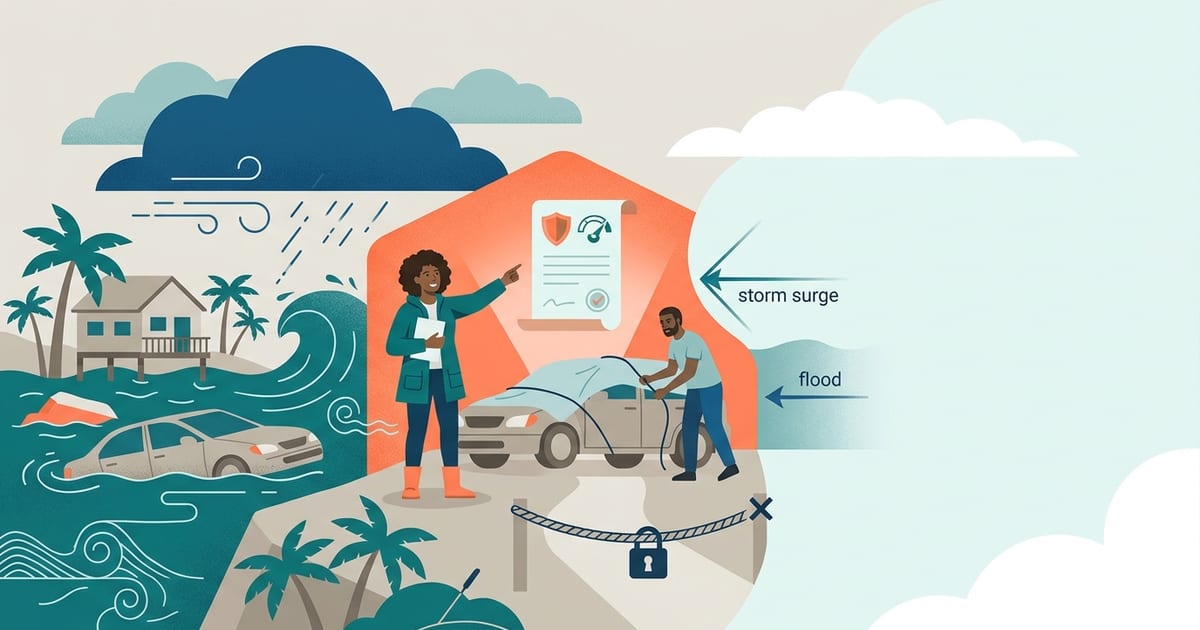
Comprehensive coverage is what pays for hurricane and flood damage to a car in Florida—wind, falling trees, flying debris, storm surge and freshwater flooding are all comprehensive claims. Liability-only and minimum policies pay nothing for your own car. Insurers suspend new policies and coverage changes once a storm watch or warning is issued, so comprehensive has to be in place before the season's first threat. Flooded vehicles are usually declared total losses because of electrical damage.
Which coverage responds
| Damage | Coverage that pays | Notes |
|---|---|---|
| Wind, hail, falling trees, debris | Comprehensive | Deductible applies |
| Storm surge, flooding, saltwater intrusion | Comprehensive | Often a total loss |
| Crash while evacuating | Collision (your car) / liability (others) | Standard crash rules |
| Damage to a car with liability-only | Nothing | Owner pays |
Binding restrictions
A binding restriction is an insurer's moratorium on new business and coverage increases in a defined area while a storm is approaching. Most Florida insurers trigger one as soon as a tropical storm or hurricane watch is issued for the state. The restriction lifts some days after the storm passes. It exists to prevent people buying coverage only when a loss is imminent, and it is why "I'll add comprehensive if a storm comes" does not work.
Before a storm
- Confirm comprehensive is on every vehicle you want protected, with a deductible you can pay.
- Photograph each car inside and out, and save your policy documents to your phone.
- Move vehicles out of flood-prone areas and away from trees; a parking garage above ground level is ideal.
- Fill the tank. Evacuation traffic is long and fuel stations lose power.
Quote finder
Find auto insurance quotes that fit your situation
After a flood
Do not start a car that has been in standing water; it can turn a repairable claim into a total loss and can be dangerous. Document the water line, report the claim promptly, and expect a total loss settlement at actual cash value if water reached the dashboard. Vehicles totalled by flood receive a branded title and should not re-enter the market as clean cars.
Questions & answers
Can I add comprehensive when a hurricane is coming?
Not once a watch or warning is issued. Insurers impose binding restrictions that block new coverage until the storm passes.
Is my car covered by home or flood insurance in a flood?
No. Homeowners and separate flood policies exclude vehicles. Only auto comprehensive covers a flooded car.
Will a hurricane claim raise my premium?
Comprehensive claims for weather are generally not charged against you the way at-fault accidents are, though statewide losses can raise base rates for everyone.
Terms used in this guide
- Comprehensive coverage
- Pays for non-crash damage to your car: theft, vandalism, fire, flood, hurricane debris, hail, animal strikes and glass. The coverage that responds to Florida storm damage.
- Actual cash value (ACV)
- What your car was worth immediately before a loss—replacement cost minus depreciation. Total loss settlements are paid at ACV.
- Total loss
- A vehicle the insurer decides to pay out rather than repair, usually because repair cost approaches its value. Flooded cars are routinely total losses.
- Binding restriction
- An insurer's temporary freeze on new policies and coverage increases in areas under a storm watch or warning.
Sources and references
Legal figures on this page (minimum limits, filing periods, statutory benefits) are checked against the primary law or the state insurance regulator listed below. Links and figures last verified Nov 2026.
- Fla. Stat. § 627.736 — required personal injury protection benefits — Florida Legislature (Online Sunshine), Fla. Stat. § 627.736Primary lawPIP: $10,000 medical and disability benefits, $5,000 death benefit; 80% of reasonable medical expenses, 60% of lost income; initial care within 14 days; $2,500 cap without an emergency medical condition.
- Fla. Stat. § 324.022 — property damage liability requirement — Florida Legislature (Online Sunshine), Fla. Stat. § 324.022Primary lawEvery owner must maintain at least $10,000 property damage liability (or a $30,000 combined single limit with PIP).
- Facts + Statistics: Auto insurance — Insurance Information Institute (2025)Statistical dataNAIC countrywide average auto expenditure: $1,127 (2022), $1,282 (2023); most expensive states in 2023 were Florida, Louisiana and New York.
- Insurance losses by make and model — Highway Loss Data InstituteStatistical dataRelative claim frequency and severity by vehicle under collision, property damage, comprehensive, PIP, MedPay and bodily injury coverages.
- What is covered by a basic auto insurance policy? — Insurance Information InstituteConsumer guidanceDefines bodily injury and property damage liability, MedPay, PIP, uninsured/underinsured motorist, collision, comprehensive and glass coverage.
- Understanding your insurance deductibles — Insurance Information InstituteConsumer guidanceHow deductibles apply to collision and comprehensive and how raising them lowers premium.
- What is gap insurance? — Insurance Information InstituteConsumer guidanceGap coverage pays the difference between a car's actual cash value and the loan or lease balance after a total loss.
Practical guidance on this page is original editorial work. Cited sources support factual statements and do not endorse this site. Dollar ranges described as typical or illustrative are editorial estimates, not figures from these sources.
Guide
Full Coverage Car Insurance in Florida
What full coverage means in Florida, when you need it, how to choose deductibles, and how hurricane season affects comprehensive coverage.
Guide
Average Cost of Car Insurance in Florida
Why Florida has some of the highest auto insurance premiums in the country, how costs vary by city and driver, and what moves the number.