

By Renata Alves · Senior Editor
Published · Updated
Answer in brief
Florida requires two coverages to register a vehicle: $10,000 in personal injury protection (PIP) and $10,000 in property damage liability (PDL). Unusually, the state does not require bodily injury liability for most drivers, which is why Florida's minimum policy is one of the thinnest in the country and why a minimum-only driver who causes a serious crash can be personally liable for the injuries. Most drivers add bodily injury liability, and lenders require collision and comprehensive on financed cars.
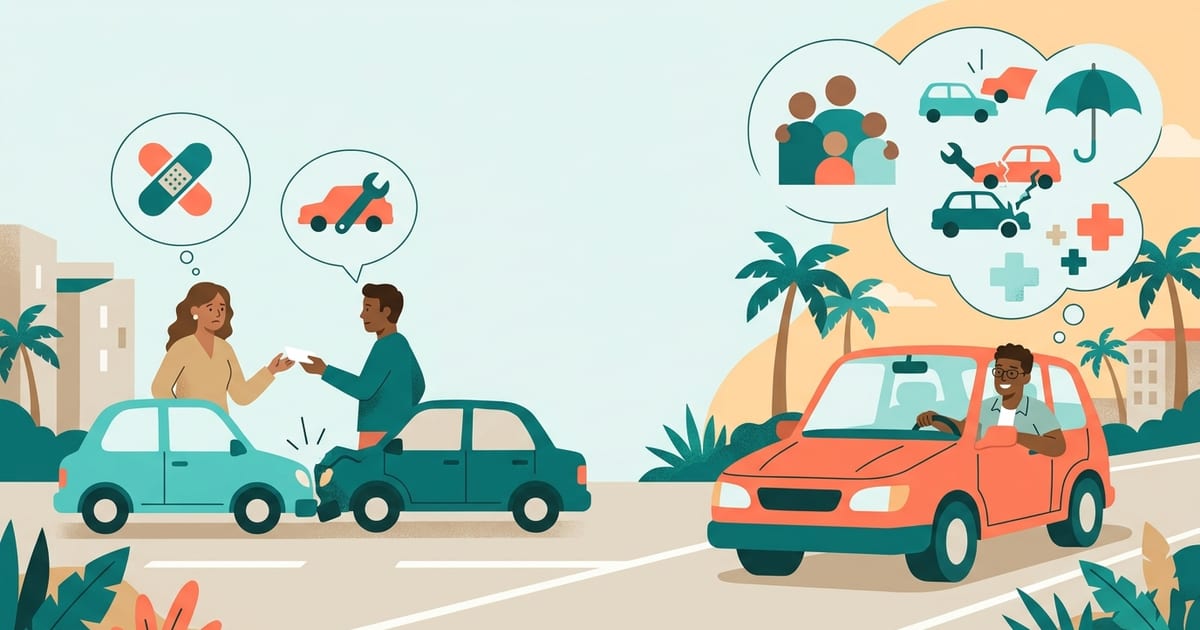
The two required coverages
Florida is a no-fault state. The required policy reflects that: PIP pays for your own medical bills and lost wages after a crash regardless of who caused it, and property damage liability pays for damage you cause to other people's property—cars, fences, buildings. Together they are often written as 10/10.
What the minimum does not cover
A 10/10 policy does not pay for injuries you cause to other people. If you are at fault in a crash where someone else is seriously hurt, the injured party can sue you personally once their own PIP is exhausted and their injuries meet Florida's permanency threshold. It also does not repair your own car. The gap between what the state requires and what protects you financially is the central theme of insurance in Florida, and it is why the full coverage guide exists.
When higher limits become mandatory
Drivers with certain convictions—most notably a DUI—are required to carry bodily injury liability of 100/300 and property damage of $50,000, documented with an FR-44 filing. Drivers who have been in a crash and were found at fault while uninsured, or who have had their registration suspended for lapses, may also be required to carry bodily injury coverage with an SR-22 filing.
Quote finder
Find auto insurance quotes that fit your situation
Keeping the policy continuous
Florida requires coverage to be continuous for as long as a vehicle has a plate, even if it is not being driven. Insurers report cancellations electronically, and a lapse leads to a registration suspension and reinstatement fees. If you are selling or storing a car, surrender the plate before you cancel the policy.
Questions & answers
Is bodily injury liability required in Florida?
Not for most drivers. It becomes mandatory after a DUI (FR-44) or certain other violations. Most drivers carry it anyway because the state minimum leaves them exposed to lawsuits.
What does 10/10 mean?
$10,000 of personal injury protection and $10,000 of property damage liability—the two coverages Florida requires.
Can I cancel insurance on a car I'm not driving?
Only after surrendering the plate. Florida requires continuous coverage on any registered vehicle.
Terms used in this guide
- Personal injury protection (PIP)
- Florida's required no-fault coverage. Pays 80% of your medical expenses and 60% of lost wages after a crash, regardless of fault, up to $10,000.
- Property damage liability (PDL)
- Required Florida coverage that pays for damage you cause to other people's property. The state minimum is $10,000 per accident.
- Bodily injury liability (BI)
- Coverage that pays for injuries you cause to others. Not required for most Florida drivers, but required after a DUI (100/300) and strongly recommended for everyone.
- No-fault insurance
- A system in which each driver's own insurer pays for their initial injury costs regardless of who caused the crash. Florida is one of about a dozen no-fault states.
Sources and references
Legal figures on this page (minimum limits, filing periods, statutory benefits) are checked against the primary law or the state insurance regulator listed below. Links and figures last verified Nov 2026.
- Fla. Stat. § 627.736 — required personal injury protection benefits — Florida Legislature (Online Sunshine), Fla. Stat. § 627.736Primary lawPIP: $10,000 medical and disability benefits, $5,000 death benefit; 80% of reasonable medical expenses, 60% of lost income; initial care within 14 days; $2,500 cap without an emergency medical condition.
- Fla. Stat. § 324.022 — property damage liability requirement — Florida Legislature (Online Sunshine), Fla. Stat. § 324.022Primary lawEvery owner must maintain at least $10,000 property damage liability (or a $30,000 combined single limit with PIP).
- Fla. Stat. § 627.737 — tort exemption and permanency threshold — Florida Legislature (Online Sunshine), Fla. Stat. § 627.737Primary lawNon-economic damages may be recovered only for permanent injury, significant scarring or death; defines the no-fault tort threshold.
- Background on: No-fault auto insurance — Insurance Information InstituteIndependent researchWhich states use personal injury protection (PIP), how no-fault thresholds work, and reform history including Michigan and Florida.
- Facts + Statistics: Uninsured motorists — Insurance Information Institute (2024)Statistical dataInsurance Research Council estimates of uninsured drivers by state (2022: e.g. Michigan 19.6%, California 17.0%, Florida 15.9%, Texas 13.8%).
- Automobile financial responsibility limits by state — Insurance Information Institute (2023)Statistical dataCompulsory coverages and minimum liability limits by state (table dated December 2023 — several states have raised limits since; see statute entries).
- What is covered by a basic auto insurance policy? — Insurance Information InstituteConsumer guidanceDefines bodily injury and property damage liability, MedPay, PIP, uninsured/underinsured motorist, collision, comprehensive and glass coverage.
- Consumer insurance information — National Association of Insurance CommissionersConsumer guidancePlain-language guides from the body of state insurance regulators; links to every state's insurance department and complaint process.
Practical guidance on this page is original editorial work. Cited sources support factual statements and do not endorse this site. Dollar ranges described as typical or illustrative are editorial estimates, not figures from these sources.
Guide
Florida PIP and No-Fault Insurance Explained
How Florida's no-fault system works, what the $10,000 PIP benefit pays, the 14-day rule, and the permanency threshold for suing.
Guide
Full Coverage Car Insurance in Florida
What full coverage means in Florida, when you need it, how to choose deductibles, and how hurricane season affects comprehensive coverage.
Guide
Uninsured Motorist Coverage in Florida
Why uninsured motorist coverage matters more in Florida than almost anywhere, stacked vs non-stacked UM, and how to choose limits.