

By Thomas Whitfield · Contributing Writer
Published · Updated
Answer in brief
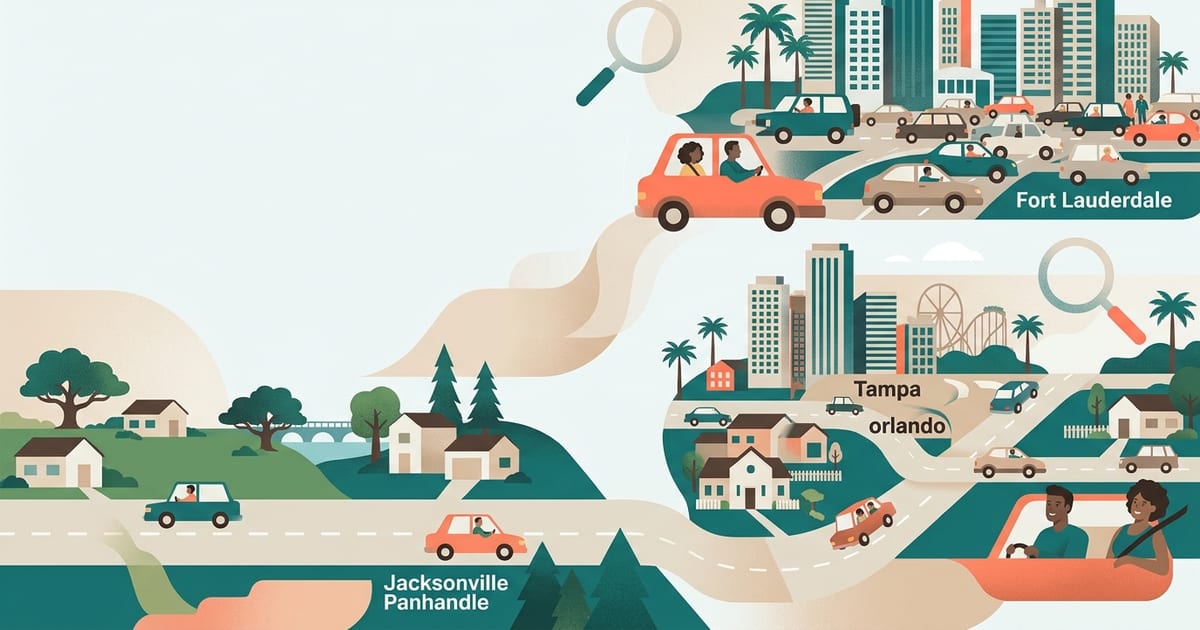
Where you garage your car is one of the largest factors in a Florida premium. Miami-Dade and Broward are the most expensive territories in the state—often 40–70% above the Florida average—driven by crash frequency, theft and litigation. Orlando and Tampa sit near the state average. Jacksonville, Tallahassee, Gainesville and the Panhandle are typically the least expensive. Within a metro, rates can change noticeably between neighbouring ZIP codes.
How territory rating works
Insurers divide the state into rating territories—usually ZIP-code groupings—and set base rates for each from the claims experience in that area. Crash frequency, injury claim severity, theft, vandalism, weather exposure and repair costs all feed in. Your own record then adjusts the base. A clean-record driver in Hialeah can pay more than a driver with a ticket in Pensacola.
Florida's cost map
| Area | Relative to FL average | Main drivers |
|---|---|---|
| Miami-Dade (Miami, Hialeah, Homestead) | +50% to +70% | Crash frequency, theft, injury litigation |
| Broward (Fort Lauderdale, Hollywood) | +35% to +55% | Density, litigation |
| Palm Beach (West Palm, Boca) | +15% to +30% | Density, high-value vehicles |
| Orlando / Orange County | 0% to +15% | Tourist traffic, growth |
| Tampa / Hillsborough | 0% to +15% | Growth, I-4 / I-275 crash corridors |
| Jacksonville / Duval | -10% to 0% | Lower density |
| Tallahassee, Gainesville, Panhandle | -20% to -10% | Low density, lower litigation |
City guides
Detailed notes for the largest metros: Miami, Orlando, Tampa and Jacksonville.
Entries in this guide
Specific questions answered in more depth.
Entry
Car Insurance in Miami
Why Miami-Dade is Florida's most expensive insurance territory, typical costs, and how Miami drivers can keep premiums manageable.
Entry
Car Insurance in Orlando
Orlando car insurance costs sit near the Florida average. What drives rates in Orange County and how to compare quotes locally.
Entry
Car Insurance in Tampa
Tampa Bay car insurance costs, the I-275 and Gandy corridors, storm surge exposure, and how Hillsborough and Pinellas rates compare.
Entry
Car Insurance in Jacksonville
Jacksonville has some of the lowest car insurance costs among Florida's large cities. Why Duval County is cheaper and what still matters.
Questions & answers
Why is Miami car insurance so expensive?
Very high crash frequency, elevated theft rates, a high share of uninsured drivers and heavy injury litigation combine to make Miami-Dade the costliest territory in Florida.
Will moving within Florida change my rate?
Yes, sometimes substantially. Update your garaging address promptly; using an old address to get a lower rate is misrepresentation.
Which Florida city has the cheapest car insurance?
Smaller northern cities such as Tallahassee and Gainesville and much of the Panhandle tend to be lowest.
Terms used in this guide
- Rating territory
- A geographic area—usually a group of ZIP codes—for which an insurer sets base rates from local claims experience.
- Premium
- The price you pay for a policy, usually quoted per six or twelve months.
- Rating factor
- Any characteristic an insurer uses to set your premium: territory, age, record, vehicle, mileage, credit-based score, coverage choices.
Sources and references
Legal figures on this page (minimum limits, filing periods, statutory benefits) are checked against the primary law or the state insurance regulator listed below. Links and figures last verified Nov 2026.
- Fla. Stat. § 627.736 — required personal injury protection benefits — Florida Legislature (Online Sunshine), Fla. Stat. § 627.736Primary lawPIP: $10,000 medical and disability benefits, $5,000 death benefit; 80% of reasonable medical expenses, 60% of lost income; initial care within 14 days; $2,500 cap without an emergency medical condition.
- Fla. Stat. § 324.022 — property damage liability requirement — Florida Legislature (Online Sunshine), Fla. Stat. § 324.022Primary lawEvery owner must maintain at least $10,000 property damage liability (or a $30,000 combined single limit with PIP).
- Facts + Statistics: Auto insurance — Insurance Information Institute (2025)Statistical dataNAIC countrywide average auto expenditure: $1,127 (2022), $1,282 (2023); most expensive states in 2023 were Florida, Louisiana and New York.
- Insurance losses by make and model — Highway Loss Data InstituteStatistical dataRelative claim frequency and severity by vehicle under collision, property damage, comprehensive, PIP, MedPay and bodily injury coverages.
- Estimated percentage of uninsured motorists by state, 2017–2023 — Insurance Information Institute (2025)Statistical dataIRC time series by state; 2023: Mississippi 28.2%, New Mexico 24.1%, D.C. 23.1%, Michigan 22.3%, Florida 20.6%, California 20.4%, Texas 14.5%; lowest Maine 5.7%.
- Fatality facts: State by state — Insurance Institute for Highway SafetyStatistical dataCrash deaths and death rates per 100,000 population and per 100 million miles by state.
- 2019–2023 Auto Insurance Database: average premium supplement — National Association of Insurance Commissioners (2025)Statistical dataCountrywide average expenditure $1,281 in 2023 (+13.98%); combined average premium $1,438; state tables for liability, collision and comprehensive.
- What determines the price of an auto insurance policy? — Insurance Information InstituteConsumer guidanceRating factors: driving record, mileage, location, age, gender, vehicle, credit-based insurance score, coverage choices. Notes ZIP-code rating is prohibited in California and Michigan and gender rating is prohibited in seven states.
Practical guidance on this page is original editorial work. Cited sources support factual statements and do not endorse this site. Dollar ranges described as typical or illustrative are editorial estimates, not figures from these sources.
Guide
Average Cost of Car Insurance in Florida
Why Florida has some of the highest auto insurance premiums in the country, how costs vary by city and driver, and what moves the number.
Guide
How to Compare Car Insurance Quotes in Florida
A step-by-step method for comparing Florida car insurance quotes on equal terms: coverage set, PIP options, UM choices, deductibles and fees.
Guide
Car Insurance Discounts in Florida
The discounts Florida insurers commonly offer—telematics, bundling, defensive driving, good student, pay-in-full—and which actually move the premium.