

By Renata Alves · Senior Editor
Published · Updated
Answer in brief
Under Florida's no-fault law, your own personal injury protection (PIP) pays the first $10,000 of your medical costs and lost wages after a crash, regardless of fault—80% of medical bills and 60% of lost income, up to the limit. You must seek treatment within 14 days of the crash to use it, and only $2,500 is available unless a medical provider determines you had an emergency medical condition. Because PIP is small, serious injuries quickly move into liability claims and lawsuits, which is why bodily injury and uninsured motorist coverage matter so much in Florida.
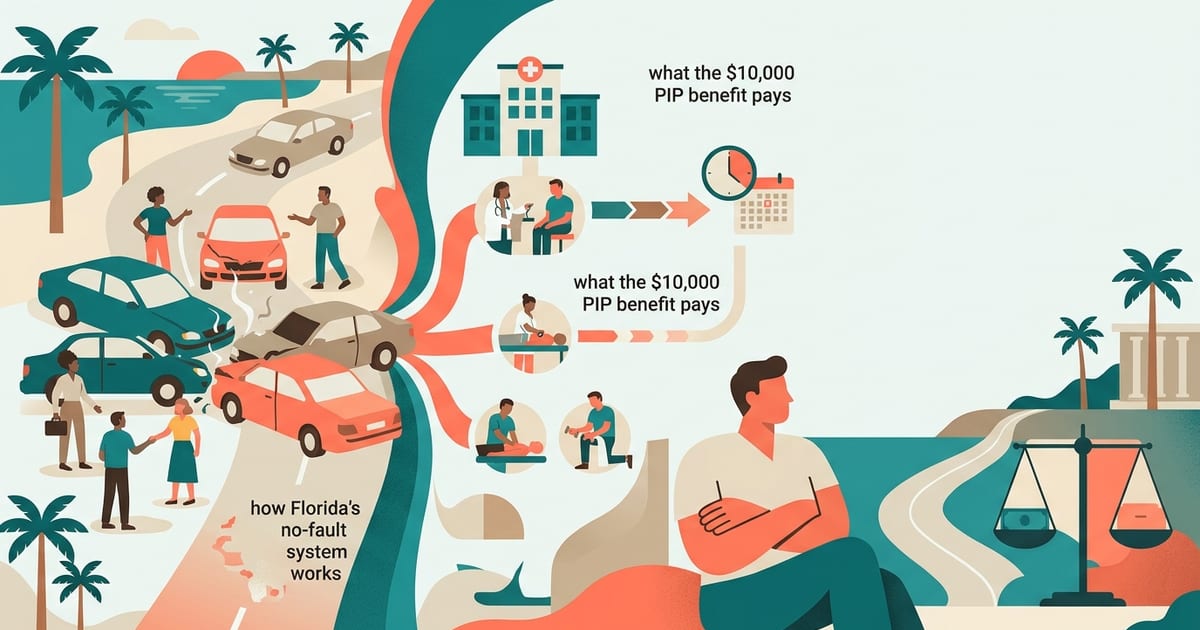
How no-fault works in practice
In a no-fault state, each driver's own insurer pays for that driver's initial injuries. The idea is to settle small injury claims quickly without arguing about blame. Fault still matters for property damage and for serious injuries—it is only the first layer of medical cost that is handled on a no-fault basis.
What PIP pays
| Benefit | Amount | Notes |
|---|---|---|
| Medical expenses | 80% of reasonable costs | Up to the $10,000 limit; $2,500 cap without an emergency medical condition finding |
| Lost wages | 60% of lost income | Shares the same $10,000 limit |
| Replacement services | Reasonable cost | Household help you must pay for because of injuries |
| Death benefit | $5,000 | In addition to medical/disability benefits |
The 14-day rule
To receive PIP benefits you must receive initial medical treatment within 14 days of the crash. Treatment from a hospital, physician, dentist or chiropractor qualifies; some follow-up providers do not. Drivers who feel fine and wait three weeks to see a doctor often discover their PIP has become unusable. If you are in any crash in Florida, get checked promptly.
The permanency threshold
No-fault limits lawsuits over pain and suffering. An injured person can sue the at-fault driver for non-economic damages only if the injury is permanent, involves significant scarring or disfigurement, or results in death. Economic losses beyond PIP—unpaid medical bills, lost income over the limit—can still be claimed from the at-fault driver's bodily injury coverage or, if they have none, from your own uninsured motorist coverage.
Quote finder
Find auto insurance quotes that fit your situation
Who PIP covers
Your PIP covers you, relatives who live with you, passengers without their own PIP, and licensed drivers using your car with permission. It also follows you as a pedestrian or cyclist struck by a vehicle. Medical payments coverage (MedPay) is an optional add-on that picks up the 20% of medical bills PIP does not pay.
Entries in this guide
Specific questions answered in more depth.
Questions & answers
Does PIP cover me as a passenger in someone else's car?
If you own a car with PIP, your own policy is primary. If you don't, the vehicle owner's PIP covers you.
What is the $2,500 PIP limit?
Without a determination of an emergency medical condition by an eligible provider, PIP medical benefits are capped at $2,500 rather than $10,000.
Is Florida getting rid of no-fault?
Repeal has been proposed several times but has not been enacted. The requirements described here are current; check the date on this page.
Terms used in this guide
- Personal injury protection (PIP)
- Florida's required no-fault coverage. Pays 80% of your medical expenses and 60% of lost wages after a crash, regardless of fault, up to $10,000.
- No-fault insurance
- A system in which each driver's own insurer pays for their initial injury costs regardless of who caused the crash. Florida is one of about a dozen no-fault states.
- Permanency (tort) threshold
- The standard an injured person must meet in Florida to sue an at-fault driver for pain and suffering: permanent injury, significant scarring or disfigurement, or death.
- Medical payments coverage (MedPay)
- Optional coverage that pays the 20% of medical bills Florida PIP does not cover, and medical costs above the PIP limit.
Sources and references
Legal figures on this page (minimum limits, filing periods, statutory benefits) are checked against the primary law or the state insurance regulator listed below. Links and figures last verified Nov 2026.
- Fla. Stat. § 627.736 — required personal injury protection benefits — Florida Legislature (Online Sunshine), Fla. Stat. § 627.736Primary lawPIP: $10,000 medical and disability benefits, $5,000 death benefit; 80% of reasonable medical expenses, 60% of lost income; initial care within 14 days; $2,500 cap without an emergency medical condition.
- Fla. Stat. § 324.022 — property damage liability requirement — Florida Legislature (Online Sunshine), Fla. Stat. § 324.022Primary lawEvery owner must maintain at least $10,000 property damage liability (or a $30,000 combined single limit with PIP).
- Fla. Stat. § 627.737 — tort exemption and permanency threshold — Florida Legislature (Online Sunshine), Fla. Stat. § 627.737Primary lawNon-economic damages may be recovered only for permanent injury, significant scarring or death; defines the no-fault tort threshold.
- Background on: No-fault auto insurance — Insurance Information InstituteIndependent researchWhich states use personal injury protection (PIP), how no-fault thresholds work, and reform history including Michigan and Florida.
- Insurance Research Council — Insurance Research CouncilIndependent researchIndependent, industry-funded research on uninsured motorists, claim trends and litigation.
- What is covered by a basic auto insurance policy? — Insurance Information InstituteConsumer guidanceDefines bodily injury and property damage liability, MedPay, PIP, uninsured/underinsured motorist, collision, comprehensive and glass coverage.
Practical guidance on this page is original editorial work. Cited sources support factual statements and do not endorse this site. Dollar ranges described as typical or illustrative are editorial estimates, not figures from these sources.
Guide
Florida Car Insurance Minimum Requirements
Florida requires $10,000 PIP and $10,000 property damage liability. What that covers, what it leaves out, and why most drivers carry more.
Guide
Uninsured Motorist Coverage in Florida
Why uninsured motorist coverage matters more in Florida than almost anywhere, stacked vs non-stacked UM, and how to choose limits.
Guide
Average Cost of Car Insurance in Florida
Why Florida has some of the highest auto insurance premiums in the country, how costs vary by city and driver, and what moves the number.