

By Renata Alves · Senior Editor
Published
Answer in brief
Florida's Personal Injury Protection (PIP) statute (Fla. Stat. § 627.736) requires individuals injured in a motor vehicle crash to seek initial medical care within 14 days to qualify for any insurance benefits. Meeting this statutory deadline unlocks up to $10,000 in medical and disability benefits if an emergency medical condition is diagnosed, or a reduced cap of $2,500 without one. Missing the 14-day window forfeits PIP medical reimbursement entirely, leaving policyholders personally responsible for initial healthcare costs.
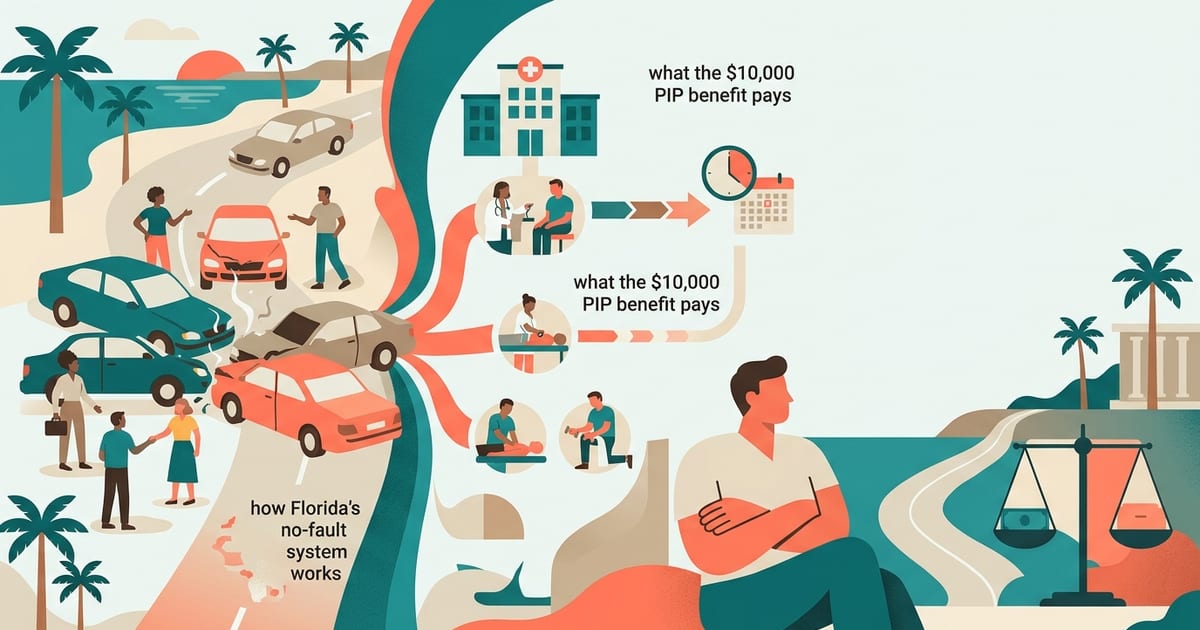
Florida operates under a mandatory no-fault insurance system designed to ensure prompt medical treatment regardless of who caused an auto collision. Under Florida Statute § 627.736, every vehicle owner must carry personal injury protection (PIP) alongside at least $10,000 in property damage liability (PDL) as outlined in Florida Statute § 324.022. However, receiving these statutory PIP benefits is subject to one critical procedural deadline: the 14-day rule.
What Is Florida's Statutory 14-Day Medical Rule?
Enacted under Fla. Stat. § 627.736, the 14-day rule mandates that any driver, passenger, or pedestrian seeking medical reimbursement under a Florida PIP policy must receive initial medical services and care within 14 calendar days after the motor vehicle crash. If you do not obtain a formal medical examination within this two-week window, your auto insurer is legally prohibited from paying PIP medical benefits for your injuries.
The statutory requirement applies even if injuries seem minor at the crash scene. Symptoms from soft-tissue trauma, concussions, or spinal sprains frequently take several days to manifest. Failing to document those symptoms with an authorized medical professional before the 14th day closes the door on your PIP claim entirely.
Statutory Benefit Caps: $10,000 vs. $2,500
Seeking treatment within 14 days does not automatically guarantee the full $10,000 statutory PIP limit. Florida law divides PIP medical reimbursements into two tiers based on the severity of the diagnosed injury:
To qualify for the full $10,000 limit, a qualified medical provider—such as a licensed physician, osteopathic physician, dentist, or advanced practice registered nurse—must formally diagnose the patient with an Emergency Medical Condition (EMC). Under Florida law, an EMC is defined as an acute condition manifesting with symptoms of sufficient severity such that the absence of immediate medical attention could place the patient's health in serious jeopardy, cause serious impairment to bodily functions, or cause serious dysfunction of any bodily organ or part.
Steps to Protect Your PIP Coverage After a Crash
Navigating the post-crash timeline correctly ensures that your insurer pays eligible medical bills and lost wage claims according to statutory guidelines.
- 1
Obtain Immediate Medical Evaluation
Schedule a medical examination promptly following any crash, even if symptoms seem mild, to establish initial care within the 14-day statutory limit.
- 2
Request Clear Clinical Documentation
Ensure that your examining clinician documents whether your injuries meet the statutory definition of an Emergency Medical Condition (EMC).
- 3
Promptly Report the Collision to Your Insurer
Notify your auto insurer to open a PIP claim and provide the official crash report details along with your provider information.
- 4
Maintain Accurate Wage and Mileage Records
Track all lost work hours and travel to medical appointments to support your 60% disability and lost earnings reimbursement claim.
When Medical Costs Exceed PIP Protection
Because PIP covers only 80% of medical bills up to a maximum of $10,000, severe crashes leave drivers with substantial unpaid balances. In addition, Florida Statute § 627.737 establishes the tort exemption threshold: you can only step outside the no-fault system to sue an at-fault driver for non-economic damages (pain and suffering) if you sustain a permanent injury within a reasonable degree of medical probability, significant and permanent scarring or disfigurement, or death.
To bridge the financial gap between basic PIP and serious injury costs, Florida drivers frequently purchase optional bodily injury liability and uninsured motorist coverage. Reviewing your policy limits annually ensures you are not exposed to high medical debts following an unexpected crash.
Questions & answers
What happens if I see a doctor on day 15 after a Florida crash?
Under Fla. Stat. § 627.736, your auto insurer is legally prohibited from reimbursing your medical expenses under PIP if your initial care occurs after the 14-day window. You become personally responsible for those bills.
Does Florida PIP cover 100% of my medical bills?
No. Florida PIP pays 80% of reasonable and necessary medical expenses and 60% of documented lost wages, subject to the $2,500 non-emergency cap or the $10,000 emergency medical condition cap.
Who can diagnose an Emergency Medical Condition (EMC) in Florida?
Under Florida law, an EMC must be diagnosed by an authorized medical professional, which includes licensed medical physicians, osteopathic physicians, dentists, physician assistants, or advanced practice registered nurses.
Does PIP cover damage to my car?
No. Personal Injury Protection covers only medical bills, disability, and death benefits. Vehicle damage is covered by Property Damage Liability (PDL) for damage you cause to others, or collision coverage for your own car.
Terms: Personal injury protection (PIP), No-fault insurance, Permanency (tort) threshold, Property damage liability (PDL), Bodily injury liability (BI)
Sources and references
Legal figures on this page (minimum limits, filing periods, statutory benefits) are checked against the primary law or the state insurance regulator listed below. Links and figures last verified Nov 2026.
- Fla. Stat. § 627.736 — required personal injury protection benefits — Florida Legislature (Online Sunshine), Fla. Stat. § 627.736Primary lawPIP: $10,000 medical and disability benefits, $5,000 death benefit; 80% of reasonable medical expenses, 60% of lost income; initial care within 14 days; $2,500 cap without an emergency medical condition.
- Fla. Stat. § 627.737 — tort exemption and permanency threshold — Florida Legislature (Online Sunshine), Fla. Stat. § 627.737Primary lawNon-economic damages may be recovered only for permanent injury, significant scarring or death; defines the no-fault tort threshold.
- Fla. Stat. § 324.022 — property damage liability requirement — Florida Legislature (Online Sunshine), Fla. Stat. § 324.022Primary lawEvery owner must maintain at least $10,000 property damage liability (or a $30,000 combined single limit with PIP).
- Background on: No-fault auto insurance — Insurance Information InstituteIndependent researchWhich states use personal injury protection (PIP), how no-fault thresholds work, and reform history including Michigan and Florida.
- Automobile financial responsibility limits by state — Insurance Information Institute (2023)Statistical dataCompulsory coverages and minimum liability limits by state (table dated December 2023 — several states have raised limits since; see statute entries).
- How to file an auto insurance claim — Insurance Information InstituteConsumer guidanceSteps after a crash: document the scene, notify the insurer promptly, understand the adjuster's role.
- How much auto coverage do I need? — Insurance Information InstituteConsumer guidanceWhy state minimums are a floor; choosing liability limits that protect assets; when collision and comprehensive are worth keeping.
- What is covered by a basic auto insurance policy? — Insurance Information InstituteConsumer guidanceDefines bodily injury and property damage liability, MedPay, PIP, uninsured/underinsured motorist, collision, comprehensive and glass coverage.
Practical guidance on this page is original editorial work. Cited sources support factual statements and do not endorse this site. Dollar ranges described as typical or illustrative are editorial estimates, not figures from these sources.